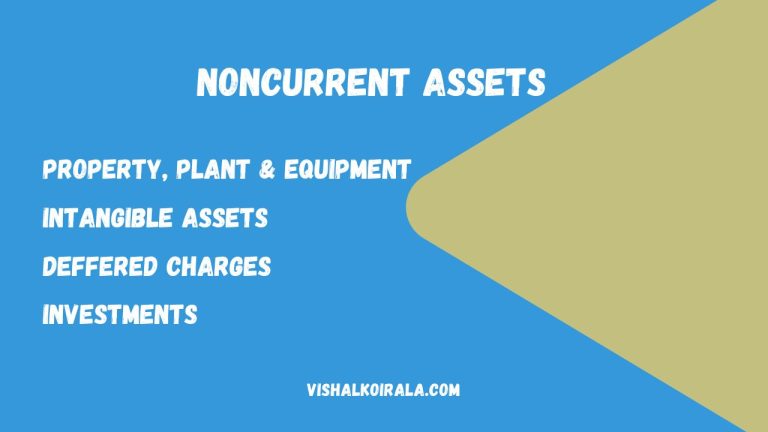
From the cash you have to the chair you sit on, everything you or your company owns are considered as Assets. These are the resources that is used by you or your business to operate and grow so, understanding personal and business assets is important, but within your business assets, they fall into two categories, current assets (which can be liquidate into cash within a year) and noncurrent assets (which are there for long-term goals).
What are Noncurrent Assets?
Any resources which are used by your company to achieve long-term goals (at least those resources which will be there in your company for more than a year) are known as noncurrent assets.
While current assets like cash and inventory keep the day-to-day running, noncurrent assets are the investment that helps your business to operate, innovate and expand for many years.
That small coffee shop which you regularly visit to have a cup of americano, may have invested in an espresso machine, grinder and furniture, exactly the noncurrent assets we are talking about.
Examples of Non Current Assets
- Your office building
- Delivery Vehicles
- Manufacturing Robot
- Patent of your software
- Investment on another company’s stock
Why Noncurrent Assets Matter?
Importance for Financial Reporting and Analysis
As noncurrent assets are in the balance sheet, a key financial statement showing what a company owns (assets) and owes (liabilities), along with all the money you have invested (equity).
For any investors, the type, value and age of noncurrent assets provide insights into the company’s operational capacity, investment strategy, and potential risks.
A small cafe, yes that similar cafe we were talking about earlier, can be viewed differently by investors if they have a modern and new espresso machine than an old espresso machine.

Driving Strategic Decisions
Strategic decisions help businesses to stand out from their competitors, but before making any decision, the management should know about the status of their noncurrent assets.
As noncurrent assets need a huge chunk of money (Capital Expenditure) to purchase and sometimes even maintain it, knowing the status of your noncurrent assets is important.
Knowing your status of noncurrent assets can help you on making decisions like, do you need to build a new factory, do you need to invest on cutting-edge software, or expand your delivery fleet.
Impact on Business Valuation
The value of business is something that every investor, or bank looks at first before thinking about investing or providing a loan for that business. The valuation ultimately depends on how your assets look, if your assets are better than your liabilities than your business is known as investable (not always).
Key Characteristics of Noncurrent Assets
- Long-term benefits: Long-term assets are expected to provide economic benefits (like that espresso machine helping generate revenue for small cafes) for more than one accounting period.
- Purpose of Use: These assets are not held for resale like inventory, but they are owned by the company to efficiently operate, or generate revenue, or maintain strategic value on long term.
- Tangibility: These kinds of assets can be tangible (physical substance, like building or machine) or intangible (lacking physical substance, like patent or brand name).
- Illiquidity: Noncurrent assets are illiquidity in nature, generally these assets are harder to convert into cash immediately. Like, selling a factory can take longer time then selling a t-shirt.
Noncurrent vs. Current Assets
| Feature | Noncurrent Assets | Current Assets |
|---|---|---|
| Definition | Assets held for use for > 1 year. | Assets expected to be converted to cash < 1 year. |
| Purpose | Used in long-term operations, revenue generation. | Used in day-to-day operations, short-term needs. |
| Liquidity | Generally Illiquid (harder to sell quickly). | Generally Liquid (easier to convert to cash). |
| Examples | Buildings, Machinery, Patents, Long-Term Investments | Cash, Inventory, Accounts Receivable, Supplies |
| Balance Sheet | Listed after Current Assets. | Listed first or before Noncurrent Assets. |
Types of Noncurrent Assets
Here are types of Noncurrent Assets:
Property, Plant and Equipment (PPE)
- Definition: Think of any physical infrastructure in a company, which are tangible in nature and are there to help companies generate economic value in future are known as PPE.
- Common Examples: Land, Buildings, Machinery, Equipments, Vehicles, Furniture, Office Equipments.
- Depreciation: As PPE wear and tear when we use it, it becomes obsolete over time, so their cost is gradually expensed over their useful life which is called depreciation.
- Learn More: Property, Plant and Equipment (PPE)
Intangible Assets
- Definition: Any assets which provide long-term value to a company but lack physical presence is known as intangible assets.
- Common Examples: Brand Value, Goodwill, Patents.
- Amortization: As tangible assets are depreciated, intangible assets with finite useful life are expensed over that life through a process called amortization.
- Learn More: Intangible Assets
Long-Term Investments
- Definition: When a company invests in another company, and has an intention to hold that investment for more than a year then it is called long-term investment.
- Common Examples: Stocks, Bonds and Properties
- Learn More: Long-term Investments
Deferred Tax Assets
- Definition: When a company overpays their taxes or has tax losses which can be carried forward to reduce future tax bills, then it is called Deferred Tax Assets. It’s essentially a prepayment of future taxes.
- When a company can recognize deferred tax assets accurately, it can reflect a company’s future tax savings on its balance sheet giving an actual financial position of the company.
Other Noncurrent Assets
- Any other assets which don’t fit into above groups, but are used for long term economic benefits, then it comes under other noncurrent assets groups.
- Common Examples: Long-term security deposits, notes receivables (due in more than one year), any restricted cash held for long-term purposes.
Accounting for Non-Current Assets
Imagine, you start a cafe shop and a very basic asset you need to purchase is an espresso machine to make coffee, and a grinder to grind beans. Now, if you don’t account for these two beautiful machines, then how would your finances look? That is why accounting is important for your non-current assets.
Now if you have understood the importance of accounting for noncurrent assets, let’s find out how they should be accounted:
Initial Recognition and Measurement
- Noncurrent assets are generally recorded in the balance sheet at their historical cost. These costs are determined by the purchase price, any cost necessary to get the asset ready for its use. (shipping, installation, legal fees)
- Capital vs. General Expenses: Important expenditures that provide future economic benefits (like buying a new machine) are capitalized (recorded as an asset). Minor repair costs that only help you to maintain those assets are expenses (recorded and shown on income statement).
Depreciation and Amortization
- The cost of tangible PPE (except land) and intangible assets with finite life is systematically allocated to expenses over their useful lives via Depreciation and Amortization.
- Depreciation and Amortization helps you to reflect the asset’s consumption or decline of value that matches the expenses with the revenue the asset helps to generate.
- Factors like the asset’s cost, estimated useful life and salvage value influence the annual depreciation/ amortization amount.
Impairment
- When carrying value (cost minus accumulated depreciation/ amortization) of a noncurrent assets on the balance sheet is higher than its recoverable amount (what you could recover through use or sale of that assets) then, an impairment loss must be recognized, reducing the asset’s value on the balance sheet and recording an expense on the income statement.
Derecognition
- When any noncurrent assets are sold, scrapped or exchanged, because there are no future economic benefits from that asset, then it is removed from the balance sheet which is called derecognition of noncurrent assets.
- In the process of disposal of assets, gain or loss is recognized according to the asset’s carrying value in the income statement.
The Impact on Financial Statements
Financial Statements consist of three reports, which are balance sheet, income statement and cash flow statement, and all of these provide insights on how a company is operating overall. To understand the value of a company, you should be able to understand the financial statement.
- Balance Sheet: Total value of noncurrent assets significantly contributes to the company’s total assets. The breakdown of non current assets (like PPE, intangibles, etc) also provides insights into the company’s operational structure and investments. Accumulated depreciation/ amortization is typically shown as reduction from the gross asset value.
- Income Statement: Any depreciation and amortization expense are recorded here, reducing net income. Income statements also consist of gain or loss on the disposal of noncurrent assets.
- Cash Flow Statement: Non current assets (CAPEX) is a major cash outflow which is reported in the investing activities section. Selling noncurrent assets generates a cash inflow, which is also reported in investing activities.
Strategic Importance of Noncurrent Assets
Beyond accounting, noncurrent assets also holds important strategic weight;
Strategic Importance of Noncurrent Assets to Investors and Lenders
- Risk Analysis and Intrinsic Value: The quality, age and type of noncurrent assets help assess operational efficiency, competitive advantage, potential risks. These are the key inputs for estimating a company’s long-term earning power and intrinsic value.
- Influence on Credit Worthiness: Noncurrent assets are often taken as collateral by lenders, so the value and the type of noncurrent assets can help you get loans.
Strategic Importance of Noncurrent Assets to Business Owners
- Asset-Backed Financing: As discussed earlier, noncurrent assets like property or equipment can often be used as collateral to secure loans, providing access to capital for growth or operations.
- CAPEX Planning and Resource Allocation: Decisions about investing in noncurrent assets (CAPEX) are important for long-term strategy. Questions like, should you invest in automation? Expand facilities? Upgrade technology? These choices can dictate future capacity and competitiveness.
Analyzing Noncurrent Assets
There are various tools and ratios to analyze a company’s noncurrent assets, which are:
Key Financial Ratios
- Fixed Asset Turnover Ratio: This helps to measure how efficiently a company is using its fixed assets (PPE) to generate sales revenue. (Net Sales/Average Net Fixed Assets). If the ratio is higher, it suggests better utilization of fixed assets. Ratios can be interpreted by comparing it to similar other industries or competitors.
- Capital Intensity Ratio: This helps to measure assets needed to generate $1 of sales. (Total Assets/ Net Sales). It can provide you with insights of how much capital you need to generate $1 of sales from your company, if it is higher, it means a more capital intensive company.
- Total Assets Turnover Ratio: This helps to understand how efficiently a company uses all of its assets to generate sales. (Net Sales/ Average Total Assets). This helps investors and business owners to understand how efficiently assets are being used overall.
Explore Further: Know More About Key Financial Ratios
Examples of Noncurrent Assets in Different Industries
The type and importance of noncurrent assets are different by industry:
- Manufacturing: Heavily reliant on PPE (factories, machinery, assembly lines).
- Technology (Software): Intangible Assets (software development cost capitalized, patents, acquired technology)
- Retail: Store buildings, leases (PPE or operating leases), warehousing facilities, point-of-sale system, brand name.
- Transportation/Logistics: Vehicles (like trucks, planes, ships), logistics software.
- Real Estate: Land and Properties.
Why Noncurrent Assets matter for Small Business?
If you are running a small business and thinking noncurrent assets may not be your thing, then you are wrong. Let’s find out how understanding noncurrent assets can help you running small business:
Tax Implications
- Depreciation Benefits: Imagine, you purchased furniture for your small business worth $5000, now, as furniture is your assets, you can’t put that into expenses and deduct your business income, but depreciation can help you eventually take advantage of tax benefits. It will help you lower the tax burden. Though you need to understand that every business has their own methods of depreciation.
- Depreciation for Small Business in the United States of America: Section 179 deduction and bonus depreciation allow businesses to deduct a significant portion (or all) of the cost qualifying assets in the year of purchase.
- Depreciation for Small Business in the United Kingdom: Annual Investment Allowance (AIA) allows businesses to deduct the full value of qualifying plant and machinery up to a certain limit. Capital Allowances apply beyond that.
- Depreciation for Small Business in Europe: Different EU members have their own capital allowance and depreciation rules, often with incentives for green investments or specific industries.
- Depreciation for Small Business in Nepal: Depreciation is allowed as per the Income Tax Act, with specific rates for different asset blocks.
- Depreciation for Small Business in India: Depreciation is allowed based on asset blocks at rates specified by the Income Tax Act. Additional depreciation may be available for new plants and machinery.
- Depreciation for Small Business in Australia: Temporary full expensing or instant asset write-off schemes may be available (check current ATO guidelines) allowing immediate deduction for eligible assets.
Financing & Investment
- Loan Eligibility: Most of the lenders assess the value of small business’s noncurrent assets when considering loan applications. Healthy, valuable assets can improve chances of approval.
- Noncurrent Assets as Collateral: Tangible noncurrent assets like property or valuable equipment can often be pledged as security (collateral) for loans, potentially securing better terms or larger loan amounts.
Noncurrent Assets vs. Fixed Assets: Difference
You may have heard the term “fixed assets” while talking about noncurrent assets. Generally both are same, but there are subtle difference, let’s find out:
What is Fixed Assets?
Assets which specifically refer to the tangible noncurrent assets which are used in operations like property, plant and equipment (PPE) are called fixed assets. Intangible assets like patents and long-term assets are not a part of fixed assets.
| Item | IFRS | GAAP | NFRS |
|---|---|---|---|
| Main Category | Non-current Assets | Long-term Assets / Non-current Assets | Non-current Assets |
| Sub-category / Common Term for PPE | Property, Plant and Equipment | Property, Plant and Equipment / Fixed Assets (common) | Property, Plant and Equipment |
| Core Concept | Largely the same across all standards. | ||
| Terminology | Slightly different in presentation. | ||