Have you ever wondered why rich people seem to get richer while the rest of us are just trying to make sure our bank account survives the week? The only secret is owning things that grow in value. That’s right, we are here talking about assets – the MVPs of personal & business success.
Take a second and think,
What are Assets?
According to The International Financial Reporting Standards (IFRS) “a resource controlled by the enterprise as a result of past events and from which future economic benefits are expected to follow to the enterprise.”
And in simple terms, anything you own that has some value and can help you make money is Assets. Think of your car – it helps you go to work, and has a resale value. Or think about your laptop – you can use it to build side hustle, trade stocks, or at least pretend working while watching cat videos 😛
One of the main reasons some people build wealth while others stay stuck in the paycheck-to-paycheck cycle are assets. In business, assets keep things running – it can be equipment, inventory, or even a brand name of your business.
Ahh, it’s confusing isn’t it? Not anymore – let’s understand assets this way.
What makes something an Asset?
To qualify as an assets (because there are some rules), something must have:
- Economic Value – It’s worth something. (Your collection of 2007 energy drinks can? Probably not.)
- Ownership or Control – Either you own it or have rights over it. (Your roommate’s PS5? Not an asset-unless you somehow convince them otherwise.)
- Future Benefit – It helps you financially in some way. (A rental property? Big Yes. A collection of NFTs? Let’s hope.)
Still confused? Let’s dive into real world example:
Picture this: You own a coffee shop. Your cash (to buy beans), Coffee Machine (to make tasty coffee), and inventory (sugar, milk, etc.) are all assets. Without them, you are just standing in an empty cafe wondering where it all went wrong.
| Feature | Personal Assets | Business Assets |
|---|---|---|
| Definition | Assets owned by individuals, for personal use. | Assets owned by business, for business purpose. |
| Examples | Home, Car, Jewellery | Equipment, Inventory, Office Space, Company Vehicles |
| Purpose | Owned for personal use and lifestyle | Owned for generating revenue and support of business operations |
| Tax | Generally not tax deductible (except in some cases) | Often tax-deductible or depreciable under business tax laws. |
| Liability Protection | Usually it is not protected from legal claims unless it is covered by insurance. | May be protected by business structure like LLCs or corporations. |
| Depreciation | Not depreciated for tax purposes. | Often depreciated to reduce taxable income. |
| Financial Reporting | Not included in business financial statements | Recorded in the business's balance sheet and financial records. |
What are the Types of Assets?
When we are talking about assets, they generally fall into different categories based on their nature and usability.
Current Assets: Resources which can be converted into cash within a year. Think about cash in hand, accounts receivable (money owed by customers), and inventory (like a clothing store’s stock) or car owned by you, stocks you are trading. These assets keep the business and your personal lifestyle running on a daily basis.
Fixed Assets: These are long-term resources used by business or individuals for their smooth operations. Like machinery in a factory, buildings owned by a company or individual, vehicles which are used for deliveries. Where, current assets, turns into cash easily, these resources are harder to turn into cash easily or quickly but they are crucial for your productivity.
While knowing about types of assets, it is also important to know assets can also be categorized in tangible and intangible assets.
Tangible Assets: Any resources which are either owned by business or individual, that can be seen or has a physical presence can be defined as tangible assets. Like, Land, furniture, laptops. Whereas,
Intangible Assets: Are assets, which are there but you can’t feel or have physical presence, like, patents for unique products, copyrights, brand value.
Here is a quick comparison between tangible and intangible assets:
| Feature | Tangible Assets | Intangible Assets |
|---|---|---|
| Physical Presence | Yes | No |
| Depreciation | Yes | Sometimes (Usually amortized over time) |
| Convertibility | Can be sold easily | Harder to sell, as value depends on market perception |
Difference Between Assets and Liabilities
As already discussed, assets are what a business or individuals owns, whereas, liabilities are what it owes. Assets bring value to a company, such as cash, inventory, Property, Plant and Equipment (PPE). Liabilities, on the other hand, are financial obligations like debts, loans or accounts payable that a business must settle over a time. The key difference between assets and liabilities is, Assets contribute to future financial benefits and Liabilities represent claims against those benefits.
Read More About Assets vs. Liabilities Here.
For any business to stay financially healthy, it must maintain a balance between assets and liabilities. Too many liabilities compared to assets can lead to financial instability, making it difficult to pay off debts. However, borrowing (a liability) can be useful if it helps acquire productive assets that help in generating income.
Case Study
Imagine you run a bakery that purchases a commercial oven for $10000. This oven is an asset because it helps to produce baked goods and generate revenue. However, if the bakery took out a loan of $5000 to purchase the oven, that loan is called liability. Now, the bakery’s goal is to use the oven efficiently, generate enough sales and ensure overall assets outweigh its liabilities.
Let’s look into this simple balance sheet to understand it more:
| Category | Amount ($) |
|---|---|
| Assets | |
| Cash | 3000 |
| Equipment (Oven) | 10000 |
| Total Assets | 13000 |
| Liabilities | |
| Loan Payable | 5000 |
| Total Liabilities | 5000 |
| Net Worth of Bakery (Assets - Liabilities) | 8000 |
Note: It’s important to maintain a healthy balance between assets and liabilities to ensure long term growth and business stability.
As we have understood what assets are, let’s try to understand why it is so important for individuals and businesses.
Why are Assets Important?
Assets are the backbone of financial stability and growth for both individuals and businesses. It represents the value and can be used to generate income, secure loans, or build long term wealth. The more valuable assets an individual or a company owns, the stronger their financial positions become.
If we look into personal finance, assets help individuals achieve financial security, like owning a home for example, building equity over time, while investments like stocks or savings accounts provide future financial benefits. A person who has strong assets can handle unexpected expenses and easily fulfill his/her long term goal such as living a healthy retirement.
Whereas, for business, assets play a critical role in operations and expansion. Equipment and inventory can generate revenue. Additionally, businesses can use assets as collateral to secure loans for expansion, such as opening in new locations or upgrading their technology. A company with a solid asset base is always more attractive to investors and lenders, as it shows financial stability.
Case
A freelance graphic designer invests $2000 in a high performance laptop. Now, this laptop is a valuable asset for the designer because it helps to complete client projects efficiently, generate income and grow business. Over time, the freelancer errands significantly more than the laptop’s cost, making it a valuable investment in career.
Keynote: Assets help to provide financial security, create more opportunities, and ensure long-term success. Whether as an individual saving for the future or a company striving for profitability, managing and growing assets is key to financial well-being.
Depreciation: How Assets Lose Value Over Time
As we already discussed how assets help you to get success, there is also a term called depreciation of those assets.
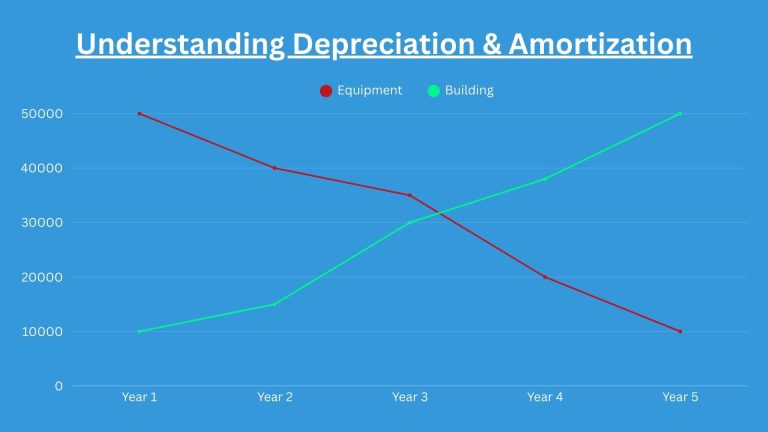
If we have to define Depreciation, it is a gradual decrease in the value of assets over time due to wear and tear, age, or being obsolete. In other terms, most of the assets don’t maintain their original worth forever – they lose value as they are used over the period of time. Mostly this is for tangible assets, but it is also important to understand that all assets don’t lose value over a period of time.
For example, vehicles depreciate quickly; a brand new truck loses its value as soon as you drive it. Or, equipment like machinery in factories wears out due to its continuous use for production of materials. Electronics, such as laptops and smartphones, become outdated as newer models are introduced.
A construction company buys a truck for $50,000. After a year of use, its market value drops to $40000, due to regular use. This means the truck has depreciated by $10000, in a year. Companies often get to record this as a loss in their financial statements to reflect the true worth of their assets
How to Manage and Track Your Assets
As we understand the importance of Assets, now let’s dive into how we can manage those assets and track them.
Keeping a track of your assets is essential for both personal and business, proper asset management can ensure that you know what you own, how much it is worth, and how its value is changing over a period of time. Managing and tracking assets is crucial to both businesses and individuals,
In case of business, tracking assets helps them with financial planning, tax deductions and depreciation calculations. For example, office furniture, computers, and vehicles lose value over a period of time, and businesses need to record these.
In the case of Individuals, tracking assets like real estate, vehicles and investments, helps in planning future expenses, insurance coverage and estate planning.
Now the next question is how we can do it?
Simple, manually tracking your assets can be time consuming, but
How Accounting Software can help us track Assets?
Software like QuickBooks, Xero, FreshBooks & ERPNext, simplifies these processes. These tools allow users to:
- Record purchase dates, values and serial numbers of those assets.
- Automatically calculate the depreciation.
- Generate financial reports for tax and audit purposes.
Manually tracking assets can be time-consuming, but accounting software like QuickBooks, Xero, and FreshBooks simplifies this process. These tools allow users to:
- Record purchase dates, values, and serial numbers.
- Automatically calculate depreciation.
- Generate financial reports for tax and audit purposes.
Actionable Tip:
You can create a digital asset register in software or a spreadsheet, listing;
- Asset Name (e.g. Office Chair, Laptop)
- Purchase Date (e.g. March 2025)
- Initial Value (e.g. $5000)
- Depreciation Method (e.g. Straight Line)
- Depreciation Rate (e.g. 20% per year)
- Current Value (Automatically Updated)
Example:
A small marketing agency buys office furniture and computers worth $5000. Using ERPNext, they log these purchases and set up automatic depreciation tracking. A year later, the software shows the updated value, helping them calculate business expenses and tax deductions efficiently.
How to Build and Grow Your Assets
As we understand the assets, let’s dive into how we can build wealth that comes from investing in the right assets. For individuals, building wealth means focusing on real estate, stocks and retirement accounts. Buying a home or rental property can generate long term value, while investing in stocks or mutual funds help grow wealth through dividends and market appreciation. Retirement accounts like 401(k)s and IRAs allow money to grow tax-free, ensuring financial security for your future.
Whereas, businesses can grow their wealth by investing in the right equipment, property, office spaces, or acquiring new technology over time. Like, a restaurant might buy a larger space or a manufacturing company could upgrade its machines to increase efficiency and revenue. These kinds of investments help businesses scale and become more profitable.
Tip:
Starting small by saving and investing in assets that appreciate over the period of time, even a modest investment into stocks or a down payment of property can lead to substantial long term growth.
Example:
If John buys a rental property for $200,00. Overtime, its value rises to $300,000, and added on that he earns $1,500 per month in rental income. By holding into appreciating assets like real estate, John can build long-term financial stability meanwhile generating passive income.
Conclusion
In summary, assets are the resources that hold value and contribute to your financial growth. They can be categorized into current assets, fixed assets, tangible and intangible assets. Understanding and managing these assets – whether through personal or business investment, is crucial for long-term financial success. Investing in assets is not only a thing, you also need to track those assets, including both depreciation or amortization, and using tools like accounting software for organization.
Either you are a business or individual, identifying your assets and regularly tracking their growth, can help you make informed decisions and build long-term wealth.